- Building a base for implants
Bone grafting for implants in Queens
- Bone grafting done in-house
- Why bone is lost
Why the jawbone shrinks
The bone that holds your teeth is kept strong by the pressure of chewing. When a tooth is removed or lost, that part of the jaw no longer receives that stimulation, and the body gradually reabsorbs some of the bone. Much of this change tends to happen in the first months after an extraction, and it can continue over the years.
Other common causes of bone loss include:
- Gum disease, which slowly destroys the bone supporting the teeth.
- Infection around a tooth root or a long-standing abscess.
- Difficult extractions, where a broken or deeply rooted tooth takes some bone with it.
- Long-term denture wear, since a denture rests on the gums rather than stimulating the bone.
- Injury to the mouth or jaw.
Bone loss is not only a problem for implants. Over time it can change the shape of the face and make dentures fit less securely. Rebuilding it gives an implant a solid foundation and helps the final tooth look natural.
- Done in-house
Extractions, bone grafting, socket preservation, implant placement and implant crowns are all done by our own dentists. Your treatment stays with one team and one written estimate.
- Measuring bone
How 3D imaging helps us plan
Before recommending a graft, we need to know how much bone you have and where. We take panoramic and digital X-rays, which show the jaw, the roots of nearby teeth and the overall picture of your mouth.
Our Maspeth office also has a 3D CBCT scanner. CBCT stands for cone beam computed tomography. Instead of a flat image, it creates a three-dimensional view of the jaw, so your dentist can see:
- The height and width of the bone where the implant will go, not just its height.
- The shape of the ridge, including thin areas that a flat X-ray can miss.
- The position of nerves, roots and the sinus close to the planned implant.
That detail helps us decide whether you need a graft at all, how large it should be, and whether the implant can be placed at the same visit. Not every case needs a 3D scan; your dentist will tell you whether it is recommended for you.
- Upper back teeth
The upper molars and premolars sit close to the sinus, where bone can be especially short. If your 3D scan shows you may need a sinus lift, we will explain why and help you plan the next step with a specialist.
- Prevention
Socket preservation: protecting bone at extraction
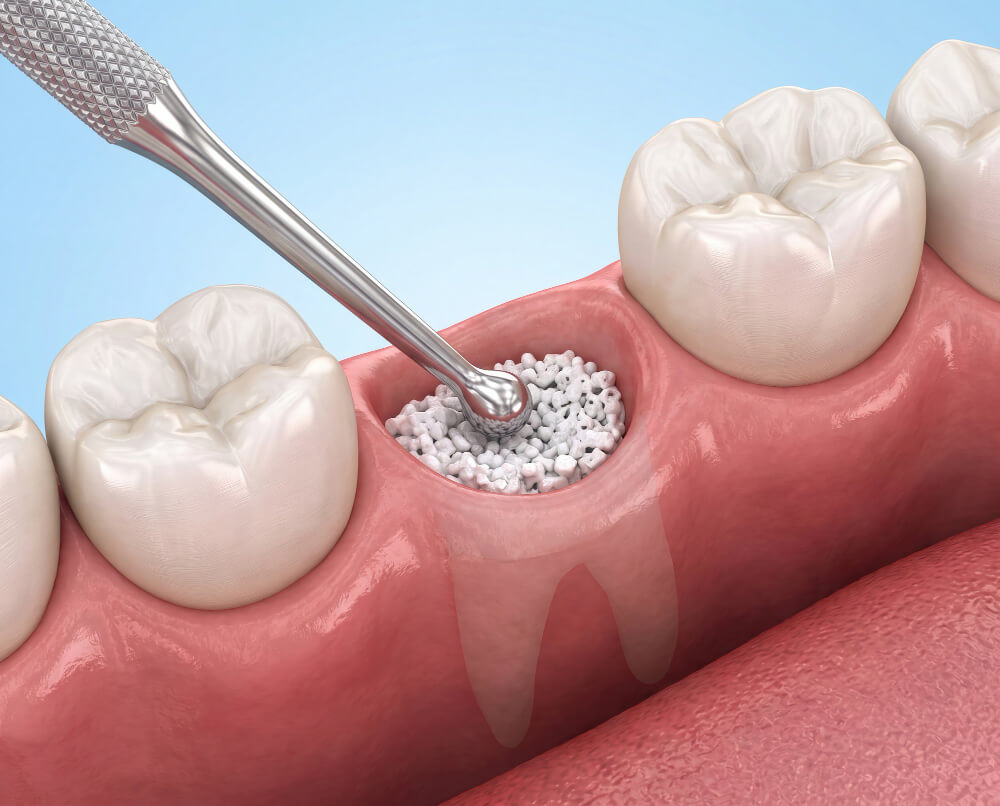
The simplest graft is often the one done the day a tooth comes out. In socket preservation, also called ridge preservation, graft material is placed in the empty socket right after the extraction. It is usually covered with a protective membrane, or the gum is closed over it.
The graft acts as a scaffold. Over the following months your own bone grows into it, which helps keep the height and width of the jaw. That makes later implant placement simpler and can reduce the need for a larger graft.
- Recommended when you plan to have an implant but it cannot be placed the same day.
- Helpful for front teeth, where preserving the gum and bone shape matters for appearance.
- Adds little time to the extraction visit itself.
If your situation allows, the implant may be placed at the same time as the extraction instead. See same-day implants for how that works. If you are having a tooth removed, including a back tooth near a wisdom tooth, ask us whether socket preservation makes sense for you.
- Planning an extraction?
Thinking about an implant before the tooth comes out gives you the most options. Ask at your exam whether to graft the socket now rather than waiting.
- Graft materials
Types of bone grafts
Bone graft materials are generally grouped by where they come from. They work in a similar way: they hold space and give your own bone cells a framework to grow into, until the graft is gradually replaced by natural bone.
- Autograft: bone taken from your own body, often from another area of the mouth. It contains your own living cells, but it requires a second site to heal.
- Allograft: human donor bone that has been carefully processed and sterilized by a tissue bank. It is widely used in dentistry and avoids a second surgical site.
- Xenograft: bone mineral from an animal source, commonly bovine, processed so only the mineral framework remains. It tends to resorb slowly, which helps maintain volume.
- Alloplast: a synthetic material, such as certain calcium phosphate products, designed to act as a scaffold for new bone.
Grafts are often paired with a membrane that keeps gum tissue out of the healing area so bone can fill in. Your dentist will explain which material is recommended for you and why.
Common grafting procedures
- Socket graft: placed at the time of extraction, as described above.
- Ridge augmentation: adds width or height to a jaw ridge that has already shrunk.
- Graft at implant placement: fills small gaps around a new implant during the same surgery.
- Questions about materials?
If you have a preference or concern about a graft source, for personal, religious or medical reasons, tell us at your consultation. There is usually more than one suitable option.
- The process
Bone grafting step by step
I
Consultation & imaging
We examine the area, review your health and take X-rays. A 3D CBCT scan at our Maspeth office may be recommended to measure the bone. You receive a written estimate.
II
Numbing
The area is fully numbed with local anesthesia, so you feel pressure rather than pain.
III
Access
The graft is placed directly into a fresh extraction socket, or the gum is gently opened to reach the bone.
IV
Graft placement
Graft material is placed where bone is needed and shaped to rebuild the ridge.
V
Protection & closure
A membrane may be placed over the graft, and the gum is closed with stitches.
VI
Healing & implant
Once the graft has matured into bone, the implant is placed, unless it was placed at the same visit.
- Recovery
Healing after a bone graft
Most people feel mild to moderate soreness and some swelling for a few days, which usually settles within the first week. Bruising on the cheek can happen and fades on its own. Small grains of graft material in your mouth during the first days are normal.
- Rest on the day of the procedure and use ice on your cheek on and off for the first day.
- Eat soft foods and chew away from the graft site.
- Avoid smoking, which can seriously slow bone healing, and avoid straws for several days.
- Do not press on the area or pull your lip to look at it.
- Rinse gently with warm salt water or the rinse we prescribe, starting the day after.
- Take any medication exactly as directed and return for your follow-up visit.
Call us if you have bleeding that does not slow with gentle pressure, swelling that keeps growing after the third day, a fever, or a large amount of graft material coming loose.
- Questions while healing?
We are a phone call away. Forest Hills (718) 830-0209, Maspeth (718) 478-6800.
- Timeline
How grafting fits into your implant timeline
Grafting can add time to implant treatment, but it is often what makes a long-lasting implant possible. Healing times vary with the size of the graft, the material used and your own healing. As a general guide:
- Graft at implant placement: no extra surgery. The implant and graft heal together over the usual few months before the crown.
- Socket preservation: the implant is commonly placed after a few months of healing, often around three to six months.
- Ridge augmentation: larger grafts may need several months, sometimes longer, before the implant goes in.
After the implant is placed, the usual bonding period follows before the abutment and crown. We give you a realistic timeline for your case at the consultation, so you can plan around work, events and travel. Read more about the full process on our dental implants page.
- Cost
Bone graft cost
The cost of a bone graft depends on the type of procedure, the size of the area and the material used, so we quote it after your exam rather than listing one price. Your written estimate shows the graft alongside the rest of your implant plan: the implant starts from $2,000, and the abutment and crown are priced together, starting from $1,500.
Some PPO plans cover part of bone grafting, particularly when it is done at the time of an extraction, but coverage varies and annual maximums apply. We accept most PPO plans and check your benefits before your visit. See our insurance page for details.
For a complete breakdown of implant pricing, insurance patterns and long-term value, read our dental implant cost guide. Cherry and CareCredit can spread the cost into monthly payments, and with Cherry, checking your options does not affect your credit score.
- Two Queens offices
Bone grafting is done in-house in Forest Hills and Maspeth. Patients rate us 4.96 on average across 657 verified Zocdoc reviews.
- Lead dentist
Dr. Kristina Yakubov, DDS
Member, ADA & NYSDA · Forest Hills & Maspeth
- Questions
Bone Grafting FAQ
A dental bone graft adds bone or bone-like material to an area of the jaw that has become too thin or short. The graft acts as a scaffold that your own bone gradually grows into and replaces. It is most often done to create a solid base for a dental implant, but it can also help preserve the jaw after an extraction.
An implant needs enough bone around it to be held firmly and to bond properly. After a tooth is lost, the jawbone in that area tends to shrink, and gum disease or infection can also destroy bone. If there is not enough left, a graft rebuilds it so the implant has a stable foundation and the final tooth looks natural.
Yes. Our own dentists perform bone grafting, including socket preservation after an extraction, at our Forest Hills and Maspeth offices, along with extractions, implant placement and implant crowns. In most cases you do not need a referral, so your implant treatment stays with one team and one written estimate. If your case ever needs a specialist, we will tell you.
Socket preservation is a bone graft placed in the empty socket right after a tooth is removed. It helps keep the height and width of the jawbone while the area heals, which makes later implant placement simpler. It is often recommended when an implant is planned but cannot be placed on the same day as the extraction.
Your exam and imaging show how much bone you have. Both offices take panoramic and digital X-rays, and our Maspeth office has a 3D CBCT scanner that shows the height, width and shape of the bone in three dimensions. Together these tell your dentist whether a graft is needed, how large it should be and when to place it.
CBCT stands for cone beam computed tomography. It creates a three-dimensional image of the jaw, rather than the flat view of a regular X-ray, so your dentist can measure bone width as well as height and see nearby nerves, roots and the sinus. We have a CBCT scanner at our Maspeth office, and it can be used for implant planning.
The procedure is done under local anesthesia, so you should feel pressure but not pain. Afterward, mild to moderate soreness and some swelling for a few days is common, and bruising can occur. Most people manage with over-the-counter pain relief or the medication we recommend, and discomfort usually eases within the first week.
Graft materials come from four general sources: your own bone, processed and sterilized human donor bone, processed animal bone mineral, or synthetic materials. Each acts as a framework for your own bone to grow into. Your dentist recommends a material based on your case, and you can raise any personal or religious preference at your consultation.
Donor and animal-derived graft materials used in dentistry are processed and sterilized to remove cells and reduce the risk of disease transmission, and they have been widely used for many years. Synthetic options are also available. If you have concerns or preferences, tell us at your consultation and your dentist will explain the choices.
It depends on the size and type of graft. Small grafts placed at the same time as an implant heal along with it. Socket grafts are commonly ready for an implant after roughly three to six months. Larger ridge grafts may need several months or longer. We give you a realistic timeline for your case at the consultation.
Sometimes. When there is enough bone to hold the implant steady, small gaps can be filled with graft material during implant placement, so only one surgery is needed. When more bone is missing, the graft is placed first and allowed to heal before the implant. Your exam and imaging guide this decision.
Choose soft foods such as yogurt, eggs, soup that is not too hot, pasta and well-cooked vegetables for the first several days, and chew away from the graft site. Avoid hard, crunchy, sticky or spicy foods and drinking through a straw. We give you written instructions on when to return to your normal diet.
Smokers can have bone grafts, but smoking reduces blood flow and can significantly slow bone healing and increase the risk of the graft or implant not taking well. We strongly recommend stopping before and after the procedure for as long as possible. Your dentist will discuss how smoking affects your particular plan and timeline.
No, we do not perform sinus lifts. They are sometimes needed for upper back teeth when the bone beneath the sinus is too short for an implant. If your 3D scan shows you may need a sinus lift, we will explain why and help you plan the next step with a specialist. We can still handle the rest of your implant care in-house.
The cost depends on the type of procedure, the size of the area and the graft material, so we quote it after your exam. It appears in your written estimate alongside the implant, which starts from $2,000, and the abutment and crown, which are priced together, starting from $1,500. Cherry and CareCredit financing are available to spread the cost.
Some PPO plans cover part of bone grafting, particularly a socket graft done at the time of an extraction, but many limit or exclude grafting for implants, and annual maximums apply. We accept most PPO plans and check your benefits before your visit, so your written estimate shows what insurance is expected to pay and what remains.
implant postPlacing an implant in bone that is too thin or short can leave the implant unstable, expose part of it, or affect the gum and appearance of the final tooth. In those cases a graft is the safer route. If grafting is not right for you, a bridge or denture may be a better option, and we will explain each one.
