
- Dental imaging
3D dental scans (CBCT) in Queens
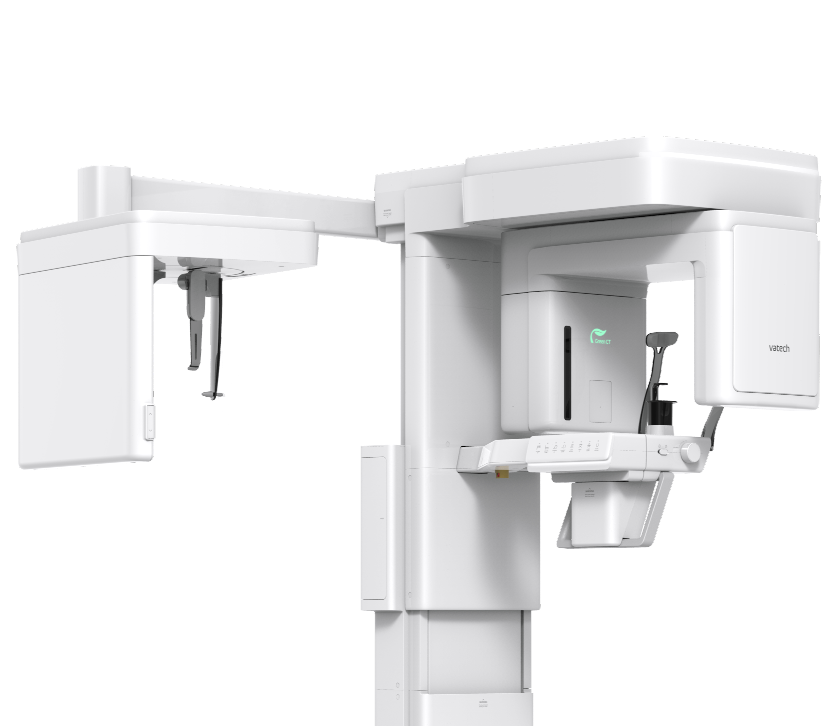
- 3D scans at our Maspeth office
Advanced 3D Imaging with the Vatech Green X
Our Maspeth office uses the Vatech Green X, an advanced digital imaging system that combines 3D cone beam CT (CBCT) and panoramic X-rays in one.
It captures highly detailed 3D views of your teeth, jaw and bone in just seconds, using Vatech’s advanced image reconstruction technology for sharper, clearer images with less noise.
The Green X is designed for low-dose imaging, so you get high-quality scans with less radiation.
For you, this means more precise implant placement, more accurate root canal and surgical planning, and fewer surprises. You see exactly what we see, and we can explain your treatment with confidence.
- In plain words
What a cone beam CT scan is
Cone beam computed tomography, or CBCT, is a type of 3D X-ray made for dentistry. You stand or sit still while the scanner turns once around your head. As it moves, it takes many images from different angles. A computer then puts these images together into a 3D model.
Your dentist can turn that model on screen and look at it from any side. We can also view thin slices through the jaw, a little like looking at the pages of a book one at a time. This lets us measure bone and see exactly where structures sit.
The name comes from the shape of the X-ray beam, which spreads out like a cone. This lets the scanner capture the whole area in a single turn.
- Where
Our CBCT scanner is at Allure Family Dentistry, 53-75 65th Place, Maspeth, NY 11378. Call (718) 478-6800. Patients who see us in Forest Hills can be scanned in Maspeth when a 3D scan is needed.
- Beyond regular X-rays
What a 3D scan shows that flat X-rays don't
Regular dental X-rays are very useful, but they are two-dimensional. Structures in front of and behind each other overlap on the image. A 3D scan separates them. It can show:
- Bone width and depth, not just height, which matters when planning an implant.
- The exact path of nerves in the lower jaw, so we can plan to keep a safe distance.
- The floor of the sinus above the upper back teeth.
- The position and angle of impacted teeth, such as wisdom teeth, and how close their roots are to nerves.
- Root shape and extra canals that can be hard to see on a flat image.
- Areas of infection or bone loss around roots that may not show clearly on regular X-rays.
- Our other X-rays
Most visits do not need a 3D scan. We also take digital X-rays, which show close-up detail of individual teeth to find cavities and check roots, and panoramic X-rays, which show all your teeth and both jaws in one wide image. We choose the image that answers the question at hand.
- Uses
When we use a 3D scan
Dental implant planning
Before placing a dental implant, we need to know how much bone there is and where nearby nerves and the sinus are. A 3D scan lets us measure the bone and plan the implant’s size, angle and position. It also helps us judge whether a same-day implant may be possible.
Bone grafting planning
If the scan shows bone is too thin or short, a bone graft can rebuild it. The scan shows where and how much bone is needed. Upper back teeth sit close to the sinus. If your 3D scan shows you may need a sinus lift, we will explain why and help you plan the next step with a specialist.
Impacted wisdom teeth
For a wisdom tooth that is trapped under the gum or angled, a 3D scan shows its position and how close the roots are to the nerve. This helps us plan a safer, more predictable extraction.
Root canal problems
When a tooth still hurts after treatment, or the cause of pain is unclear, a scan can reveal extra canals, cracks in the root or infection around the root tip. This helps guide root canal treatment.
- Seeing it together
We show you your scan on screen and explain what we see in plain words. Many patients find it easier to understand their options when they can see their own bone and teeth in 3D.
- Safety
Radiation and safety
Like all X-rays, a CBCT scan uses a small amount of radiation. Dental CBCT scans are generally a much lower dose than a medical CT scan of the head, because the scanner is designed for the jaws and takes the images in a single quick turn. The dose is higher than a single small dental X-ray, which is why we do not use 3D scans routinely.
- We take a 3D scan only when it will help answer a clinical question or plan your treatment.
- When a regular digital or panoramic X-ray gives us what we need, we use that instead.
- Please tell us if you are pregnant or think you might be, so we can discuss whether the scan can wait.
If you have questions about imaging, ask us. We will explain why we recommend a scan and what it will show.
- Cost & insurance
Insurance coverage for 3D scans varies by plan. We check your PPO benefits before your visit and include the scan in your written estimate when it is part of your treatment plan. Cherry and CareCredit offer monthly payments for larger treatment.
- What to expect
Your 3D scan, step by step
I
Before the scan
We explain why the scan is needed. You remove glasses, earrings, hairpins and anything metal around your head and neck.
II
Positioning
You stand or sit in the scanner. We position your head and may ask you to bite gently on a small guide to keep still.
III
The scan
The scanner turns once around your head. It is quick, painless and you do not need to be inside an enclosed tube.
IV
Reviewing the images
Your dentist reviews the 3D images and talks you through the findings and next steps.
- Digital impressions
No more goopy impressions
Along with our 3D CBCT scanner and X-rays, we take digital impressions of your teeth with intraoral scanners, the new 3Shape TRIOS 6 at our Maspeth office and the iTero scanner, the scanner made for Invisalign, at our Forest Hills office.
A small wand is moved gently around your teeth while a camera records thousands of images. In a few minutes, the software builds an accurate 3D model of your teeth and bite on the screen in front of you.
- More comfortable: no trays of impression putty and less gagging.
- Accurate: a precise digital model helps crowns, bridges and aligners fit well.
- Faster: the scan is sent digitally to the lab, with no waiting for molds to be shipped.
- See it yourself: we can show you your teeth in 3D and explain what we see.
- Used for
Invisalign and clear aligners, crowns, bridges, implant crowns, night guards and retainers.
- Questions
3D Dental Scans (CBCT) FAQ
CBCT stands for cone beam computed tomography. It is a 3D X-ray made for dentistry. The scanner turns once around your head and takes many images from different angles, which a computer combines into a 3D model of your teeth, roots, jawbone, nerves and sinuses. Your dentist can view it from any angle on screen.
Our CBCT scanner is at Allure Family Dentistry, 53-75 65th Place, Maspeth, NY 11378. You can call the Maspeth office at (718) 478-6800. Patients who usually see us in Forest Hills can be scanned in Maspeth when a 3D scan is needed for their treatment.
A regular dental X-ray is a flat, two-dimensional image, so structures can overlap. A CBCT scan is three-dimensional. It shows bone width and depth, the exact position of nerves and the sinus, and the angle of impacted teeth. Regular digital and panoramic X-rays are still the right choice for most everyday checkups.
A CBCT scan uses a small amount of radiation. Dental CBCT scans are generally a much lower dose than a medical CT scan of the head, though higher than a single small dental X-ray. We take a 3D scan only when it will help plan your treatment, and we use regular X-rays when they give us what we need.
No. The scan is painless. You stand or sit still while the scanner turns once around your head. You may bite gently on a small guide to help keep still. There is no injection and nothing goes in your mouth other than the bite guide. The scan itself takes a short time.
The scan itself is quick. The scanner makes a single turn around your head. Including getting positioned and removing glasses or jewelry, the whole process usually takes just a few minutes. Your dentist then reviews the images and explains the findings. If the scan is part of implant or extraction planning, we usually go over it with you during the same visit.
No. A dental CBCT scanner is open. You stand or sit while a small arm moves around your head. You are not placed inside a tube, so most people who feel uncomfortable in enclosed spaces find it easy. Let us know if you are nervous, and we will talk you through each step.
An implant needs enough bone to hold it, and it must be placed a safe distance from nerves and the sinus. A flat X-ray shows bone height but not width. A 3D scan lets us measure the bone in all directions and plan the implant’s size, angle and position. It also shows whether bone grafting may be needed.
Not always. Many wisdom teeth can be assessed with a panoramic X-ray. When a wisdom tooth is deeply impacted, angled or its roots appear close to the nerve in the lower jaw, a 3D scan shows the exact relationship. This helps us plan a safer, more predictable extraction.
Yes. When a tooth still hurts after a root canal, or it is hard to find the cause of pain, a 3D scan can show extra canals, cracks in the root or infection around the root tip that may not appear clearly on a flat X-ray. This helps us decide the best next step.
Please tell us if you are pregnant or think you might be. Elective dental imaging is often postponed during pregnancy unless it is needed for urgent care. We will discuss whether the scan is necessary now or can wait, and what the safest plan is for you.
Wear comfortable clothing. Before the scan, we ask you to remove anything metal around your head and neck, such as glasses, earrings, necklaces, hairpins and removable dental appliances like dentures or retainers. Metal can create shadows on the images. If you have something that cannot be removed easily, just let us know before the scan.
Coverage for CBCT scans varies by plan. Some PPO plans cover part of the cost when the scan is needed for treatment such as implants or a difficult extraction, and others do not. We check your benefits before your visit and include the scan in your written estimate when it is part of your treatment plan.
Yes. We show you your 3D images on screen and explain what we see in plain words. Many patients find it easier to understand their bone, nerves and treatment options when they can see their own scan. Ask us any questions you have.
Yes. For most crowns, bridges, implant crowns and Invisalign cases we take digital impressions with intraoral scanners, the 3Shape TRIOS 6 at our Maspeth office and the iTero scanner made for Invisalign at our Forest Hills office. A small wand records your teeth in a few minutes, so there is no impression putty and the 3D model is sent straight to the lab.
A CBCT scan is a 3D X-ray that shows bone, roots, nerves and the inside of the jaw, which is why it is used for implant and surgical planning. An intraoral scan is a digital camera scan of the outside of your teeth and gums, used to make crowns, bridges and aligners. It uses no radiation.
