- Pricing, insurance & financing
Dental implant cost in Queens
- A written estimate before treatment
- Our prices
What dental implants cost at Allure Dental
| Implant (placed in the jawbone) | From $2,000 |
| Abutment + Crown (together) | From $1,500 |
| Bone graft, if needed | Quoted after your exam |
| Implant-supported denture or implant bridge | Written estimate before treatment |
For a single missing tooth, the total is the implant (from $2,000) plus the abutment and crown together (from $1,500). If you need a bone graft first, or the tooth still has to be removed, those are added to the plan. You see every line item in writing before you decide.
- Our promise on price
No surprise fees. After your consultation you receive a written estimate that lists each part of treatment, what your insurance is expected to pay, and what is left for you.
Prefer to spread it out? See financing with Cherry or CareCredit.
- What you are paying for
The three parts of a dental implant
When you compare prices, make sure you are comparing the whole tooth, not just one piece of it. A complete single-tooth implant has three parts:
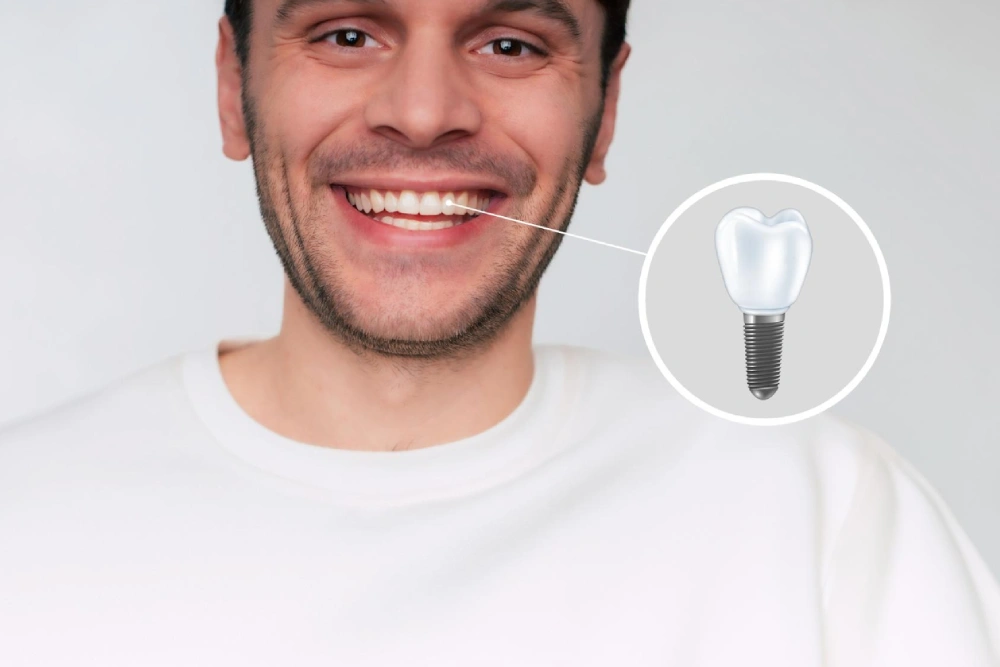
- The implant. A small titanium post placed in the jawbone that acts as the artificial tooth root. The implant starts from $2,000.
- The abutment. A connector that attaches to the top of the post and holds the crown. It can be a stock part or custom-made for your gumline, which is one reason it is quoted at your consultation.
- The implant crown. The visible tooth you chew with, shaped and shaded to match your natural teeth. The abutment and crown together start from $1,500.
Placement, the crown and the abutment are all done in-house by our own dentists, so in most cases you do not need a referral to another office. That keeps your care in one place and your estimate in one document. Learn more about the treatment itself on our dental implants page.
- Watch for this
An advertised implant price may cover only the post. Ask whether the abutment, crown, X-rays and any bone graft are included. Our table above shows each part so you can compare fairly.
- Why prices vary
Factors that change the cost of an implant
Two patients can both need “one implant” and still have very different treatment plans. These are the main things that move the total up or down:
- Number of teeth. Each implant has its own fee. When several teeth are missing in a row, an implant bridge supported by two implants may replace three or four teeth with fewer posts than one per tooth.
- Bone grafting. If the jawbone has thinned since a tooth was lost, a bone graft may be needed to give the implant a solid base. Some grafts are placed at the same visit as the implant; others need several months of healing first.
- Sinus position. Upper back teeth sit close to the sinus, and the bone beneath it can be too short for an implant. If your 3D scan shows you may need a sinus lift, we will explain why and help you plan the next step with a specialist.
- Extraction first. If a damaged tooth is still in place, it has to be removed. In some cases the implant can go in the same day, which we explain on our same-day implants page.
- Crown material. Crowns can be made from different ceramics, such as zirconia or porcelain-based materials. Your dentist recommends a material based on strength, appearance and where the tooth sits.
- Location of the tooth. Front teeth demand more attention to gum shape and appearance. Back molars take more chewing force and may need a wider implant or a sturdier crown. Both can affect the plan.
- Overall gum health. Active gum disease needs to be treated before an implant, because healthy gums help an implant last.
- Already had a tooth out?
The longer a gap stays empty, the more bone the jaw tends to lose. If you are planning an extraction, ask about socket preservation, which can reduce the need for a larger graft later.
- Insurance in New York
Does dental insurance cover implants?
Sometimes, and usually in part. Coverage for implants varies a great deal from plan to plan, even within the same insurance company. These are patterns we commonly see with PPO dental plans:
- Annual maximums are limited. Most dental plans cap what they pay each year. That cap is often well below the full cost of an implant, so even good coverage usually leaves a balance.
- Crowns are covered more often than posts. Many plans pay part of the implant crown as a major service, even when they do not cover the post itself.
- Waiting periods. Some plans require you to be enrolled for a set time before major services are covered.
- Missing tooth clauses. Some plans do not pay to replace a tooth that was missing before your coverage began.
- Alternate benefits. Some plans pay only what they would have paid for a less costly option, such as a bridge or denture, and apply that amount toward the implant.
You do not need to work this out on your own. We accept most PPO plans, including Aetna, BlueCross BlueShield, Cigna, Delta Dental, Guardian, MetLife, UnitedHealthcare and many others, and we check your benefits before your visit. Some treatment can also be staged across two plan years so you use two annual maximums. See our insurance page for the full list, including the plans we do not accept.
- Payment options
Cherry: checking your options does not affect your credit score, with 0% APR for qualifying patients and no deferred interest.
CareCredit: a health care credit card you can use for dental treatment.
Details on our financing page.
- Long-term value
Implant vs bridge vs denture: cost over time
The price on day one is only part of the story. It helps to think about what each option costs over the years you will rely on it.
Dental implant
An implant usually has the highest upfront cost. In return, it stands on its own without involving the neighboring teeth, and it helps preserve the jawbone where the tooth was lost. With good care, implants can last for many years and often decades. The crown on top may eventually need replacing from normal wear, but the post usually stays.
Dental bridge
A bridge often costs less at the start and can be finished faster. The trade-off is that the teeth on either side are shaped to hold crowns, and those teeth carry extra load. Bridges are generally replaced at some point, and if a supporting tooth develops a problem, the whole bridge may need to be redone.
Removable denture
A partial or full denture is typically the lowest upfront cost. Dentures rest on the gums, so the bone underneath keeps shrinking over time. That often means relines, adjustments and replacement dentures over the years. An implant-supported denture is a middle path: a few implants hold the denture firmly in place.
There is no single right answer. We will lay out each option with its cost so you can choose what fits your health, your budget and your plans.
- Doing nothing has a cost too
A gap left open can let neighboring teeth drift and the opposing tooth over-erupt, and the bone in that spot slowly shrinks. Waiting can turn a simple implant into one that needs grafting first.
- Low prices & travel
Why a cheap implant can cost more
It is natural to shop around. A very low price can be a fair deal, but it is worth asking what is behind it.
- Partial pricing. The quoted price may cover only the post, with the abutment, crown, X-rays or grafting added later.
- Unknown components. Implant systems differ. If parts are hard to source, a future repair or crown replacement can be harder and more costly.
- Rushed timelines. Implants need time for the bone to bond. Skipping healing time to fit a trip or a promotion can raise the risk of problems.
- Follow-up care. Implants need checkups, cleanings and sometimes adjustments. If your dentist is far away, small issues can become larger ones before they are seen.
Dental tourism appeals to some people because of lower fees abroad. When you add travel, time away from work and the cost of fixing problems back home, the savings can shrink or disappear. With a local practice, the same team that placed your implant is close by for every follow-up visit.
- Questions to ask any office
Does the price include the post, abutment and crown? Are X-rays and follow-up visits included? Who places the implant and who makes the crown? Will I get the full cost in writing before I start?
- Your consultation
What happens at your implant consultation
I
Exam
Your dentist examines the gap or damaged tooth, your gums and your bite, and reviews your health history and any medications.
II
X-rays & 3D imaging
Panoramic and digital X-rays show the bone, nearby roots and, for upper back teeth, how close the sinus sits. For implant planning we can also use the 3D CBCT scanner at our Maspeth office. This is what makes an accurate estimate possible.
III
Your options
We explain whether an implant suits you and compare it honestly with a bridge or denture, including timelines and whether a bone graft is likely.
IV
Written estimate
You leave with a written estimate for each step, what insurance is expected to cover, and financing options. There is no pressure to decide on the spot.
- Two Queens offices
Implants in Forest Hills & Maspeth
Implant consultations are available at both of our offices. Our Forest Hills office at 105-05 69th Ave, Suite 112A, is open Sunday through Friday, including Sundays from 10 to 3:30. Our Maspeth office, Allure Family Dentistry at 53-75 65th Place, is open Monday through Thursday.
Patients rate us 4.96 on average across 657 verified Zocdoc reviews, with 4.99 for bedside manner. Dr. Kristina Yakubov speaks Russian, and our front desk speaks Spanish, so you can talk through your treatment and costs in the language you are most comfortable with.
Our Maspeth office also has a 3D CBCT (cone beam CT) scanner, which gives a three-dimensional view of the jawbone for implant planning.
Ready for real numbers? Book a consultation and we will check your insurance before you arrive.
- Call the office near you
Forest Hills: (718) 830-0209
Maspeth: (718) 478-6800
- Lead dentist
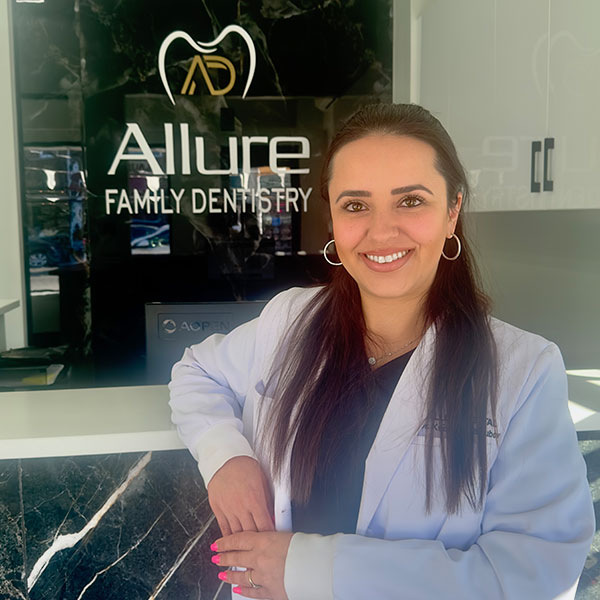
Dr. Kristina Yakubov, DDS
Member, ADA & NYSDA · Forest Hills & Maspeth
- Questions
Dental Implant Cost FAQ
At Allure Dental, the implant starts from $2,000, and the abutment and crown are priced together, starting from $1,500. If you need a bone graft or an extraction first, those are added. Your exact cost depends on your exam and X-rays, and you receive a written estimate before treatment.
Yes. The abutment and crown are priced together, starting from $1,500.
A complete single-tooth implant has three parts: the implant placed in the jawbone, the abutment that attaches to it, and the crown you see and chew with. The implant starts from $2,000, and the abutment and crown are priced together, starting from $1,500. Your written estimate outlines your treatment costs so you know exactly what is included.
Not everyone does. A graft is needed when the jawbone has become too thin or short to hold an implant securely, which often happens after a tooth has been missing for a while. We can only tell from your exam and imaging, so bone graft fees are quoted after your exam and included in your written estimate.
We have a 3D CBCT (cone beam CT) scanner at our Maspeth office, and both offices take panoramic and digital X-rays. A 3D scan shows the height, width and shape of the jawbone and the position of nearby structures, which can help plan implant size and placement. Your dentist will tell you whether a 3D scan is recommended for your case.
Some PPO plans cover part of implant treatment, and many cover part of the implant crown. Coverage varies widely, and most plans have an annual maximum that limits how much they pay each year. We accept most PPO plans and check your benefits before your visit, so your estimate shows what insurance is expected to cover and what remains.
No. We do not accept Medicaid, Healthfirst, HealthPlus, MetroPlus, Fidelis, Affinity, HMO or DMO plans, or union and community dental plans. We do accept most PPO plans, including Aetna, Cigna, Delta Dental, Guardian, MetLife and UnitedHealthcare. If your plan is not accepted, Cherry and CareCredit financing can help spread the cost into monthly payments.
Yes. We offer Cherry and CareCredit. With Cherry, checking your options does not affect your credit score, and qualifying patients can get 0% APR with no deferred interest. CareCredit is a health care credit card that can be used for dental treatment. Our team can walk you through both at your consultation or on our financing page.
Upfront, an implant usually costs more than a bridge. Over time the gap narrows, because an implant does not involve the neighboring teeth and helps preserve the jawbone, while a bridge is generally replaced at some point and depends on the teeth that support it. We compare both options with real costs at your consultation so you can decide.
A removable denture is usually the lowest upfront cost, but dentures rest on the gums and the bone underneath tends to shrink, which can mean relines and replacements over the years. Implants feel more like natural teeth and help keep the bone. For people who prefer a denture, a few implants can hold it firmly in place.
A low advertised price may cover only the implant, not the abutment, crown, X-rays or other steps. It may also involve less familiar implant parts or a shortened healing time. Before choosing, ask any office what the full price for a finished tooth is and whether you will receive it in writing. We list every part so you can compare fairly.
Fees can be lower in some countries, but travel, time off work and multiple trips add up. Implants need healing time and follow-up visits, and if a problem appears after you return home, fixing it locally can cost more than the original savings. Having your implant placed close to home means the same team is nearby for every checkup.
It can. Front teeth need careful attention to gum shape and appearance, which can affect the abutment and crown chosen. Back molars handle more chewing force and may need a wider implant or a stronger crown. Upper back teeth sit close to the sinus, so the bone height there is checked carefully. Your dentist explains how your tooth’s location affects the plan and cost.
Each implant has its own fee, but you do not always need one implant per tooth. When several teeth in a row are missing, two implants can often support a bridge of three or four teeth. Implant-supported bridges and dentures are priced with a written estimate after your exam, because the number of implants depends on your bone and bite.
Yes, for an accurate price. An exam and X-rays show your bone, gums and nearby roots, which determine whether you need a bone graft, which implant size suits you and what crown fits best. Without them, any quote is a guess. After your consultation you receive a written estimate listing each step and its cost before anything begins.
Often, yes. Because implant treatment takes several months, the implant may fall in one plan year and the crown in the next, which can let you use two annual maximums. Whether this helps depends on your plan’s rules. We check your benefits and can suggest timing that makes the most of your coverage, without rushing your healing.
Waiting does not always cause problems right away, but the bone where a tooth is missing tends to shrink over time. Neighboring teeth can also drift into the gap. That can turn a straightforward implant into one that needs a bone graft first, which adds cost and time. If you are not ready yet, ask us about your timeline.
In most cases, no. Our own dentists place implants, perform bone grafting, remove teeth and make implant crowns in-house at our Forest Hills and Maspeth offices. That keeps your care and your estimate in one place. If your case ever needs a specialist, we will tell you honestly and explain why.
